

Itineraries
Việt Nam in 7, 10 or 14 Days: Routes That Actually Fit
Three field-tested routes through a 1,600-kilometre-long country — with the pacing rules that stop a dream trip from becoming a transport schedule.
By Trip2VN Editorial · 13 min read · Published Jul 18, 2026
How to think about a Việt Nam route
Việt Nam is long and thin — more than 1,600 kilometres from the northern mountains to the Mekong Delta — and it holds three different climates at once. That single fact shapes every good itinerary. You cannot see the whole country in a week, and the trips that try are remembered mostly for their bus seats.
The good news is that the country organises itself naturally into a route. The north has Hà Nội, Hạ Long Bay and the mountains. The centre has Huế's imperial past and Hội An's lantern-lit old town, with Đà Nẵng's airport conveniently between them. The south has Sài Gòn's energy and the Mekong's slow water world. Fly into one end, out of the other — the open-jaw ticket usually costs little more and saves you a full day of backtracking.
Below are the three route lengths we plan most often, each field-tested across hundreds of trips. Treat them as strong skeletons, not scripture: the right version of each depends on your season, your pace and who is travelling — which is exactly what our itinerary builder and our specialists are for.
The pacing rules that save every trip
Count bases, not sights. A base is a place you unpack. Three bases in a week is comfortable; four is brisk; five is a logistics exercise with occasional sightseeing. Every rule below follows from this one.
Travel days are real days. A morning flight plus an airport transfer plus a hotel check-in consumes more of a day than the timetable admits. Plan something gentle for arrival afternoons, never a highlight.
Give your landing city two nights. Day one you arrive; day two you actually see it. One-night stops belong only to overnight boats and trains, where the journey is the point.
Use the country's distances honestly. Hà Nội to Sài Gòn is about two hours by air. Đà Nẵng sits roughly midway, under ninety minutes from either end. The overnight train between Hà Nội and the centre is a genuine experience as well as transport — but it is a full night, and it arrives with a train's punctuality, not a plane's.
Check the calendar for Tết. Around Lunar New Year — late January to mid-February, depending on the year — much of the country goes home to family. Transport sells out weeks ahead and many businesses close for days. It is a fascinating time to be here and a hard time to travel around; plan for one or the other.
7 days: the classic north and centre
One week is enough for two regions done properly. Our default: the north's icons, then the centre's charm, flying home from Đà Nẵng.
Days 1–2, Hà Nội. Land, walk the Old Quarter at dusk, eat early and well. Day two for the capital itself: the leafy French quarter, Hoàn Kiếm lake at morning exercise hour, a street-food crawl with egg coffee to finish.
Days 3–4, Hạ Long Bay. Board an overnight cruise — the two-and-a-half-hour transfer is part of the plan, not a delay. Kayak in the afternoon, wake at anchor among the karst. Return to Hà Nội and take the short flight to Đà Nẵng.
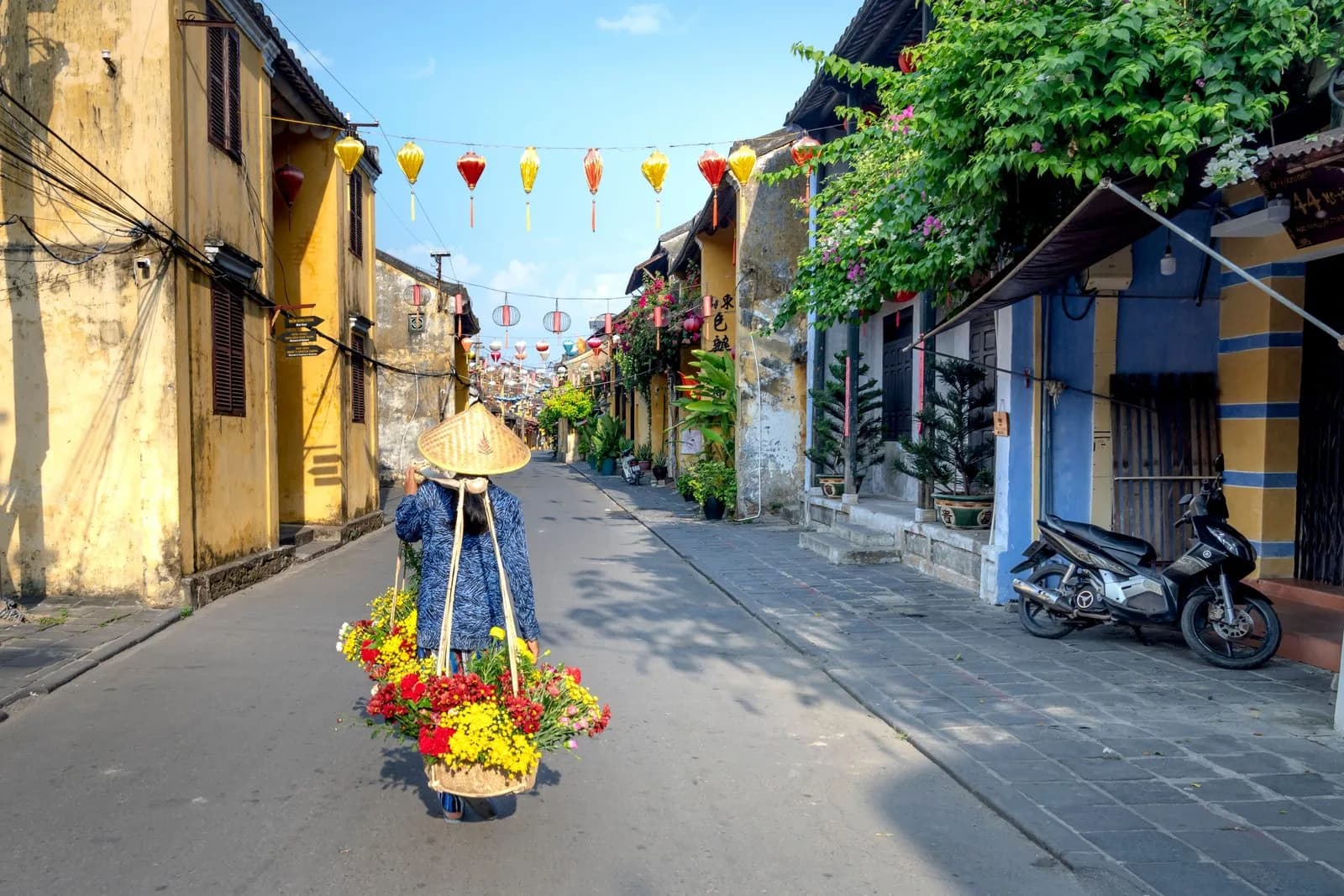
Days 5–7, Hội An. Three nights in one place on a one-week trip is a deliberate luxury. The old town before breakfast, when it belongs to residents; a bicycle through the rice paddies to the beach; a tailor if you want one; the lanterns after dark. Fly out of Đà Nẵng, forty-five minutes up the road.
The honest trade-off: this route skips the south entirely. If Sài Gòn and the Mekong call louder than karst and lanterns, invert the idea — two days in Sài Gòn, a night on the delta, then fly north to finish in Hà Nội and the bay. What does not work in seven days is trying to do both ends and the middle.
10 days: add depth, then add the south
Ten days buys you the seven-day route plus two upgrades: an inland day in the north and a first taste of the south.
Days 1–2, Hà Nội, as above.
Days 3–4, Hạ Long Bay overnight, as above.
Day 5, Ninh Bình. Two hours south of Hà Nội, the same karst as the bay rises out of rice fields instead of the sea. A rowing boat through the waterways of Tràng An, a climb to a viewpoint at golden hour, a quiet lodge for the night. It is the north's most underrated day.
Days 6–8, Hội An via the Đà Nẵng flight. Three nights again — the old town rewards slowness more than any other stop in the country.
Days 9–10, Sài Gòn. Fly south into a different country in all but passport: faster, louder, younger. One day for the city — the war-era history told at its museums, the alleys where the best food hides, rooftop lights after dark. If the water world calls, trade the second city day for a Mekong day trip and come back for a final dinner.
The shape to notice: this route still averages three nights per base where it matters. The extra days went into depth, not distance — that is almost always the better spend.
14 days: the full spine
Two weeks is where Việt Nam opens up properly — mountains, bay, imperial city, old town, metropolis, delta, and time to breathe between them.
Days 1–2, Hà Nội.
Days 3–4, the mountains. The expressway makes Sa Pa a comfortable add: terraced valleys, high ridgelines, a hike with a local guide through villages that farm the steepest fields you will ever see. Two nights is the minimum that respects the travel time. (Hà Giang's celebrated loop needs four days of its own — save it for a dedicated trip rather than squeezing it in.)
Days 5–6, Hạ Long Bay overnight, then back to Hà Nội to fly south the next morning.
Days 7–9, Hội An, three nights, with a half-day trip to the Mỹ Sơn sanctuary ruins if ancient brick and jungle appeal.
Day 10, Huế. Up the coast road — one of the country's great drives, over the Hải Vân pass — to the imperial citadel and a night by the Perfume River. Huế's food alone justifies the stop.
Days 11–12, Sài Gòn, flying from Huế. The city deserves the same two-night respect as Hà Nội.
Days 13–14, the Mekong Delta. A night on the water world — floating markets at first light, fruit orchards, a homestay dinner cooked by people who grew what you are eating. Return to Sài Gòn for departure.
Prefer a beach ending? Swap the delta for Phú Quốc island and finish horizontal. It is a different trip — slower, saltier — and an entirely legitimate one.
When the season should reshape the route
September to November flatters every route above: the north is at its clearest and the south is drying out. The one caution is the centre, where the heaviest rain and occasional flooding arrive in mid-to-late autumn — keep the Hội An segment flexible and let a specialist watch the forecast.
December to February is dry-season gold in the south and genuinely cold in the northern mountains — Sa Pa can drop near freezing. Weight your nights southward: more Sài Gòn, Mekong and islands; keep Hà Nội and the bay but pack for it.
March to May is the most even window across all three regions, and our quiet favourite for the fourteen-day spine.
June to August brings heat everywhere, brilliant rice terraces in the north, afternoon downpours in the south that clear as fast as they arrive — and school-holiday crowds at the famous stops. Book the bay and beach segments earlier than feels necessary.
The mistakes we undo every week
The five-base week. See the pacing rules above; this is the one we rescue most often.
Hạ Long as a day trip when the calendar had room for a night. Ten hours of travel for four on the water, when one more day buys sunrise at anchor.
A masterpiece on landing day. Jet lag does not care what you booked. Arrival day is for walking, eating and going to bed early.
Ignoring Tết. Every year, someone plans a perfect ten days across the exact week the country goes home. Check the lunar calendar before you buy flights.
Back-to-back early flights. One dawn departure is a strategy; three is a holiday spent in security queues. Mix in the train, the coast road, the boat — the journeys here are attractions when you let them be.
Make it yours
These three skeletons cover most first and second trips, but the best itinerary is the one shaped around your dates, your pace and your people. Our itinerary builder on this site lets you sketch that shape in a few minutes — pick your days and regions, and it drafts the bones of a route. From there, a specialist who has driven these roads checks it against the season and comes back with a day-by-day plan and a clear quote.
No itinerary survives contact with a good trip unchanged, and that is fine. The skeleton's job is to make sure the changes happen over coffee in Hội An — not in a taxi you did not need to be in.
The next step
Bring this into your trip
Tell us what caught you here — a specialist builds the days around it and replies with a clear price.
Plan this trip