

The Mekong
The Floating Markets of the Mekong
At first light on the Mekong, boats laden with fruit trade in near silence. The floating markets are not a tourist stage — they are how the delta feeds itself.
By Trip2VN Editorial · 10 min read · Published Jul 12, 2026
Before the Tourists Wake
In the Mekong Delta, water has always been the primary infrastructure. Roads are rivers, highways are canals, and the rhythm of life is the rhythm of the tide. Markets grew where the water traffic was heaviest, and they persist — though their character has shifted with time and tourism.
A floating market exists by necessity. The villages of the delta stand on stilts, spread across islands and embankments, separated by channels of brown water. To gather a market — where growers can sell to buyers and wholesalers can trade with retailers — you meet where the boats already pass. The floating market is not romantic or quaint. It is functional. It is how the delta has always done business.
The largest and most visited is Cái Răng floating market near Cần Thơ, where boats gather in the pre-dawn dark to trade. But there are smaller, lesser-known markets across the delta where the tourism machinery has not yet arrived. These serve locals: a farmer with a few hectares of orchard selling to a wholesaler from a neighbouring province, the quiet early-morning economy that feeds the whole region.
The trading begins long before first light, when boats start arriving from the outlying orchards and farms. In the last hour of darkness the water fills with commerce: boats selling tropical fruit and vegetables, boats selling live fish, shrimp and eels, boats carrying supplies — ice, baskets, rope. By the time the sky begins to lighten, the serious transactions are mostly done.
The boats are small and heavily laden, produce piled high and lashed with rope. The farmers work from their decks — weighing on hanging scales, negotiating, counting money. There is little wasted motion. Someone loads a truck at the bank for a bigger market inland; someone else is a retailer buying for their own stall. Prices are agreed on the water, often almost without words: a gesture, a nod, done.
The language of the market is the southern Vietnamese of the delta — fast, clipped, a working shorthand that outsiders, even Vietnamese from the northern cities, struggle to follow. The rhythm of the speech mirrors the rhythm of the trade: quick, decisive, always moving. There is no time for formal greetings. Someone has produce to sell. Someone has money to spend. The transaction is the greeting.
The Produce and the Seasons
What is on the boats changes with the season. In the flood months, roughly May to October, the water rises and the markets shift slightly — some to higher ground, some into deeper channels. The boats carry what grows in water: water spinach, morning glory, gourds and squashes. As the water recedes, new crops appear — melons, pumpkins, and wave after wave of tropical fruit.
Mangoes come in more varieties than most visitors knew existed, each corner of the delta loyal to its own. Coconuts arrive whole, still in the husk, stacked by the dozen. Banana boats hang their cargo from bamboo frames — bunches within bunches, a cascading kind of abundance. Dragon fruit travels up from the southern growing areas towards Cần Thơ and beyond.
Fish and shrimp arrive on the same water, often straight from the night's fishing. The fish are kept alive where possible, in baskets slung just below the waterline, or packed fast in ice if they are travelling far. Much of the small shrimp is destined not for the table directly but for the fermented pastes and sauces that underpin delta cooking.
Who Still Comes
The Mekong has changed dramatically within living memory. Upstream dams have altered the flow. The climate has shifted planting seasons. Mechanised farming has made many small plots unviable, and the cities keep drawing the young away. By any objective measure, the floating markets should already be gone.
And yet the boats still come before dawn. The older farmers still navigate by memory, by knowledge handed down through generations. Engines have replaced oars on most boats, but the basic pattern is unchanged: orchard to market, market to wholesaler, wholesaler to table.
The traders who remain tend to be older — people who have worked the water all their lives. Some are known by their boat, some by what they carry: the mango seller, the dragon-fruit family. They come year after year, season after season, and the buyers know them by sight.
But each year there are fewer boats, and the delta asks itself an unspoken question: how much longer? A generation, perhaps. Two, with luck.
The Tourist Market and the Real One
Visit Cái Răng in the comfortable mid-morning hours and you will see a market optimised for tourism. Tour boats arrive in clusters, guides narrate, vendors quote visitor prices, cameras outnumber baskets. It is not false, exactly — the market does still trade at that hour, and the produce is real — but it is a version of the market arranged for short visits.
To see the real one, you go out in the dark, in a small boat arranged the night before, and sit quietly in the middle of it. You will be one of very few outsiders. No one will try to sell you anything. The market will not slow down for you. You are simply an observer in a working place.
The smaller markets, further from the city, do not run every day and see almost no tourists at all. They serve local farmers, local wholesalers, local retailers. The prices are the prices the delta actually pays. The bargaining is real.
How to Do It Properly
- Go out in the dark. The market's real life happens before sunrise; arrive with the last of the night and watch it fill. By full daylight you are watching the final hour. - Arrange a boat and a local boatman the evening before. A small, simple boat is better than a motorised tour boat — quieter, less intrusive, easier to move through the crowd. - Accept the silence. Much of the pleasure is watching commerce happen without commentary. A good guide answers questions; a good guide does not narrate. - Bring small notes. If you buy fruit off a boat, no one will have change for big bills. - Consider a lesser-known market. Cái Răng is impressive but busy. The smaller markets ask more effort and give back more.
After the Market
As the morning trade winds down, the boats disperse. Some dock at small landings where produce is loaded onto trucks; some moor for the day while their owners retreat to riverbank cafés to drink coffee and talk through the morning's business; some head straight back to the orchards to prune and water before the next market day.
For visitors who made the early start, there is usually a reward: breakfast at a plain riverside eatery, where the menu reflects what has just been sold — a fish noodle soup, rice porridge with fried shallots, a whole grilled fish with herbs and a saucer of fish sauce. Eaten at a table above the quieting water, it is often the best meal of the whole trip: it tastes of first light, of work, of a place whose essentials have not changed in a very long time.
If a dawn on the water sounds like your kind of morning, tell us — we can build a Mekong leg around it and come back to you with a route and a clear quote.
The next step
Bring this into your trip
Tell us what caught you here — a specialist builds the days around it and replies with a clear price.
Plan this trip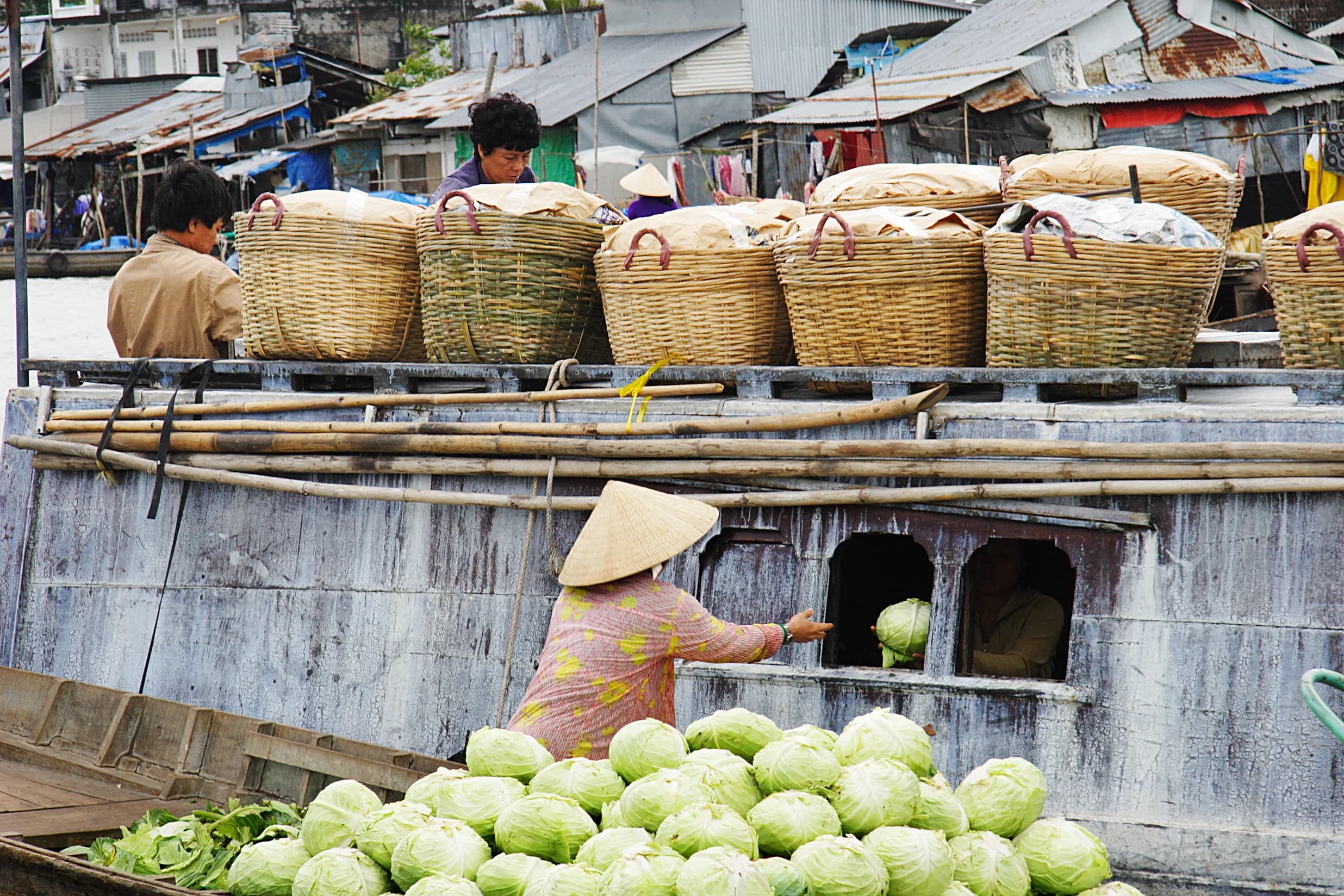 A trip that goes thereMekong Delta3 days · From ~$140